The promotional products industry does $26.1 billion in annual revenue in the U.S. alone (PPAI 2024 report). But the majority of company store platforms limit their catalogs to 200–500 pre-decorated SKUs from a handful of preferred suppliers. That means when your team wants something specific — a particular backpack for a sales kickoff, a jacket from a brand not in the system — the store becomes a bottleneck instead of a solution.
This is what I call the Backpack Test. Ask your current provider: "What happens if we want a product that is not already in the catalog?" If the answer involves a separate project, a different team, a longer timeline, or a surcharge — that is the gap.
According to ASI research, 72% of buyers say product variety is their top criterion when choosing a promotional products partner. A fixed catalog structurally limits variety.
The real cost of catalog-only sourcing
When a buyer cannot find what they need in their company store, one of three things happens: they settle for a product that does not fit the use case, they go outside the approved program entirely (creating brand control issues), or the request dies and the opportunity is lost. Industry surveys show that 40% of corporate merch requests are abandoned when the process feels too complex or limited (Counselor Magazine, 2023).
Off-catalog sourcing eliminates this problem at the root. Instead of curating a fixed assortment and hoping it covers every use case, the model starts with what the buyer actually needs and works backward to find the right product, price, and fulfillment path.
How volume pricing actually works
Most people understand "buying in bulk is cheaper" — but the mechanics matter. Blank apparel (before decoration) typically drops 30–45% in unit cost between quantities of 24 and 144. Decoration setup charges ($40–75 per screen or digitizing file) get amortized across more units. A polo that costs $18.50/unit at 48 pieces might cost $12.20/unit at 288 pieces — same shirt, same quality, 34% savings just from understanding break pricing.
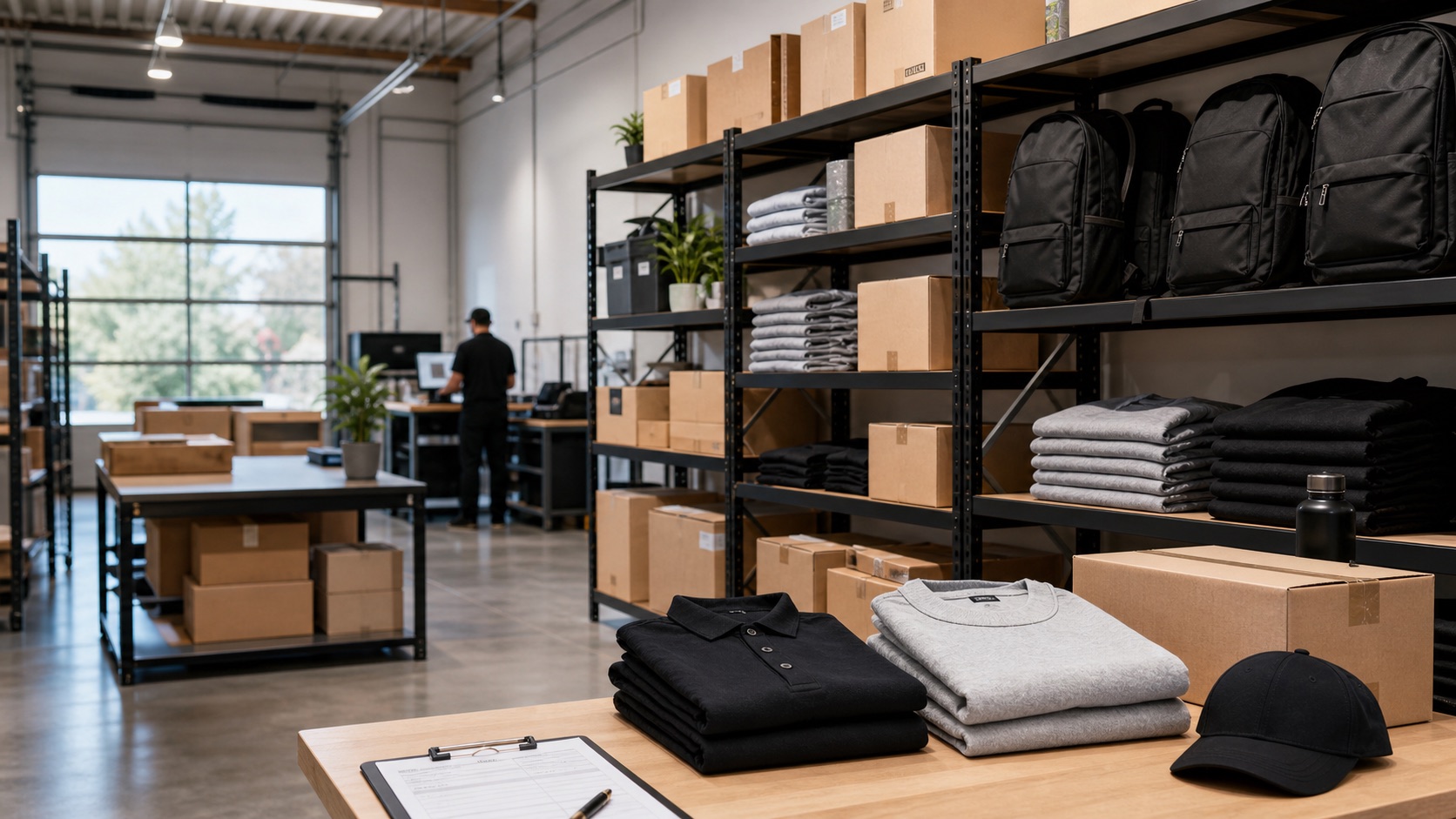
When you can source off-catalog and buy at volume, you are not paying the retail markup that platform catalogs build in. You are buying at distributor cost and storing inventory for future use, which turns a single order into a multi-month or multi-year asset.
Warehouse inventory changes the math
Holding 200 units in a warehouse at $0.15–0.50/unit/month costs far less than reordering in small batches at higher per-unit pricing. A company ordering 50 branded backpacks quarterly at $22/unit ($4,400/year) could instead order 200 at $15/unit ($3,000 once) and store them for under $400/year. Total savings: over $1,000 and zero reorder lead time.
This is not theoretical — it is basic supply chain math that most company store platforms do not offer because their model depends on per-order transaction fees, not inventory management.