A 2023 PPAI study found that 63% of companies with 100+ employees use three or more separate vendors to manage their branded merchandise — one for the online store, another for event orders, a third for warehousing, sometimes a fourth for international shipping. Each vendor has its own portal, its own pricing, its own timeline. The admin managing the program spends more time coordinating vendors than actually running the merch program.
This fragmentation exists because most platforms were built to solve one problem well: Merchology is strong at branded apparel and gifting. SwagUp and Swag.com excel at swag packs and kitting. Custom Ink owns the group-order and fundraiser space. Printful and Printify handle print-on-demand. But none of them were designed to be the single operational layer underneath all of it.
The result: your company store handles some orders, but anything outside its scope becomes a side project managed through email, spreadsheets, and one-off invoices.
The average corporate merch program with 3+ vendors spends 12–18 hours per month just on vendor coordination — ordering, tracking, reconciling invoices, and chasing shipments across systems.
What "full operation" actually means
A complete merch operation has seven layers: (1) Product selection and sourcing, (2) Artwork and brand control, (3) Inventory decisions — on-demand vs. bulk vs. hybrid, (4) Budget rules and approval workflows, (5) Order fulfillment and shipping, (6) Tracking and reporting, (7) Exception handling — returns, replacements, late shipments, size exchanges.
Most platforms cover 2–3 of these layers. The rest falls on the buyer. That is why a "simple company store" still generates 40+ emails per month for a mid-size program — because the platform handles the ordering but not the operation around it.
The fulfillment model comparison
On-demand printing (Printful, Printify): No minimum order, ships in 3–7 business days, but unit costs are 2–3x higher than bulk. A printed t-shirt that costs $8 blank + $3 decoration in bulk costs $18–24 through print-on-demand. Works for low-volume or highly variable designs, but expensive at scale.
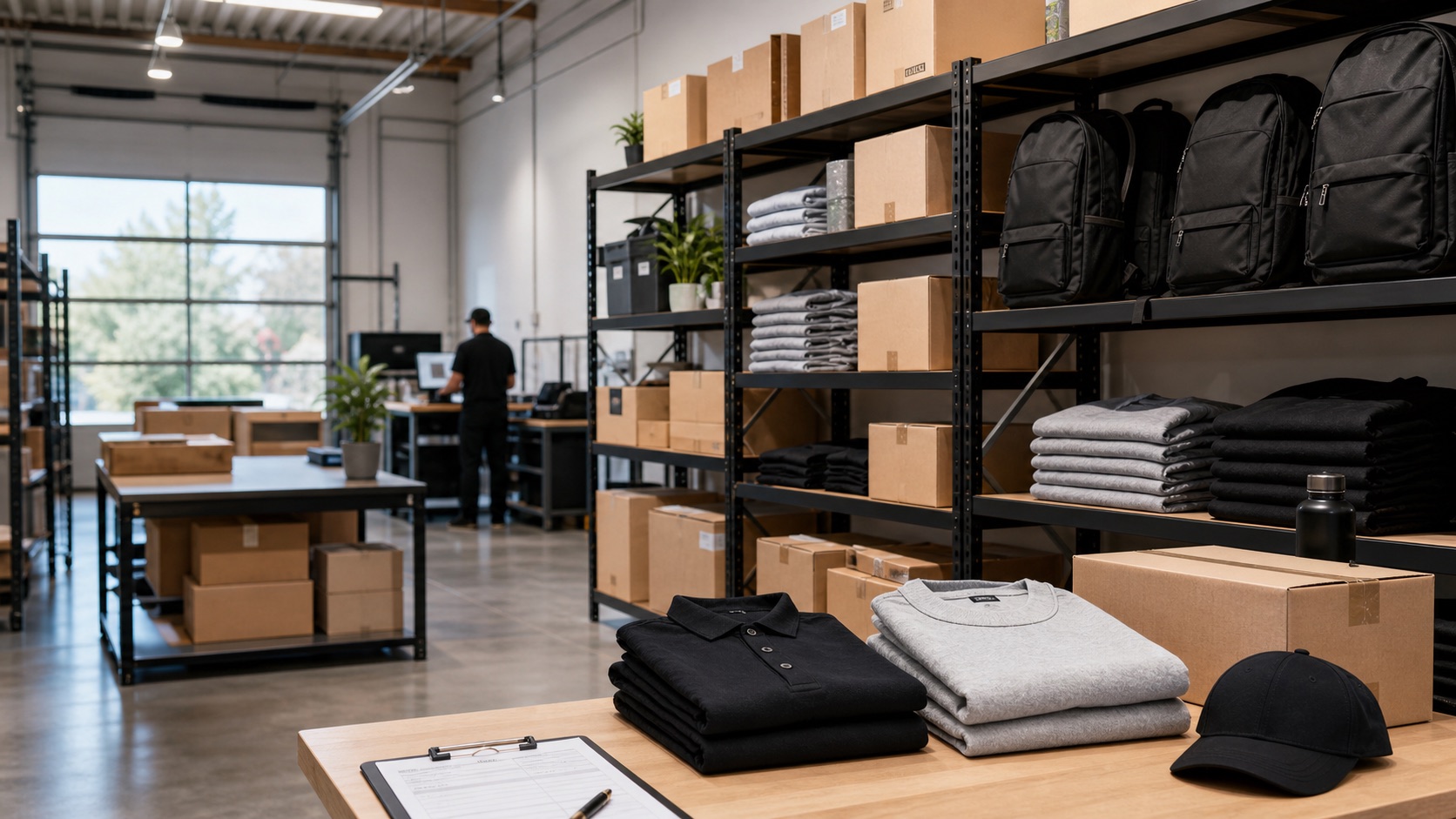
Bulk + warehouse: Lower unit cost (often 50–60% less than on-demand), but requires upfront investment and storage fees. Best for items you know you will use — onboarding kits, core branded apparel, event staples.
Hybrid model: Use on-demand for the long tail (items ordered less than 10x/month) and bulk inventory for high-velocity SKUs. This is the model that saves the most money over 12 months. A typical 200-employee company running a hybrid program saves $8,000–15,000 annually compared to pure on-demand.
The hidden cost of "free" platforms
Many company store platforms advertise "no setup fees" or "free storefronts." The economics still work because they build 40–60% markup into every product sold through the store. A $25 polo in their catalog costs $10–12 at distributor pricing. The "free" store is paid for by every single order, forever.
A managed operation with transparent pricing (cost + margin) typically saves 20–35% on product costs alone. Add warehouse efficiency and bulk sourcing, and the total program cost can drop 30–50% compared to a markup-based platform — even after paying for the operational service.